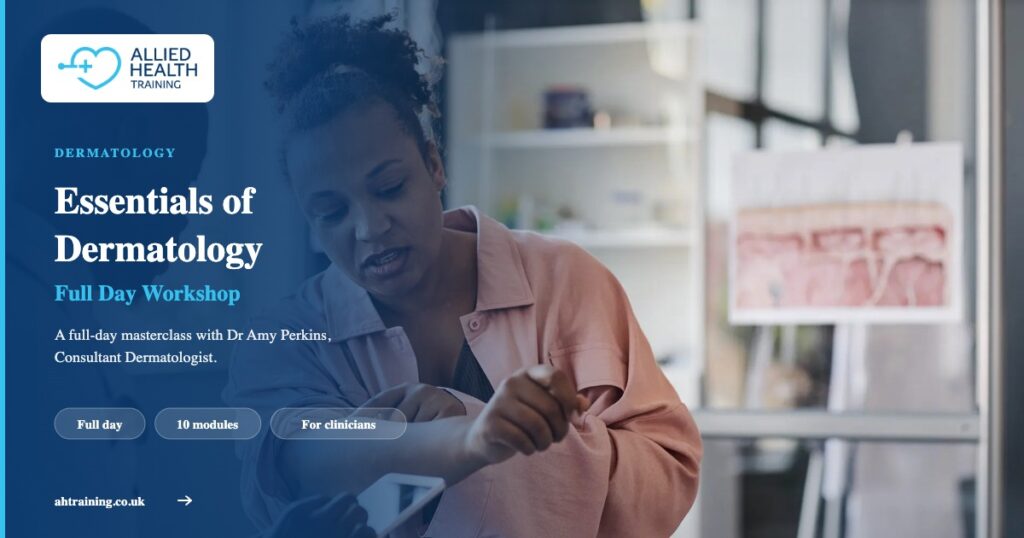
A full-day, specialist-led masterclass for pharmacists, nurses, advanced practitioners and GPs.
Led by Consultant Dermatologist Dr Amy Perkins, this immersive workshop closes the gap between everyday clinical consultations and the complexity of real-world dermatology. Across ten modules you’ll build pattern recognition, sharpen referral decisions and counsel safely on everything from topical steroids to skin cancer. Designed to avoid death by PowerPoint, the day stays interactive throughout, with role play, triage simulations and visual diagnostic challenges that turn knowledge into confident, medicolegally safe practice.
Who it’s for
Built for clinicians who see skin every day
If patients bring you rashes, lesions, treatment questions or red flags, this day is for you. No prior dermatology training is assumed.
Audience list
- Pharmacists
- Nurses
- Advanced Clinical Practitioners
- General Practitioners
- Other registered healthcare professionals
What you’ll take away (outcomes)
By the end of the day, you’ll be able to
Outcomes
- Recognise common inflammatory, infective, pigmentary and neoplastic skin conditions.
- Distinguish benign lesions from those that are suspicious and need referral.
- Advise safely on both over-the-counter and prescribed treatments.
- Address fears and misconceptions around topical steroids and steroid withdrawal.
- Identify dermatological emergencies that require urgent referral.
- Understand the psychological impact of skin disease and respond with compassion.
- Manage cosmetic and appearance-related queries ethically and safely.
How you’ll learn
- Role play and communication: practise the hard conversations, including steroid-phobic patients, compassionate referrals, inappropriate cosmetic requests, and patients convinced of infestation.
- Triage and escalation simulations: work in small groups through evolving cases, deciding when to reassure, treat, safety-net or escalate urgently.
- Visual diagnostic challenges: timed recognition exercises with high-quality clinical images to build pattern awareness and diagnostic humility.
- Peer learning and reflection: compare reasoning pathways with colleagues and reflect on different approaches to the same presentation.
The programme (curriculum)
Ten modules across one full clinical day
From the most common presentations to the emergencies you cannot afford to miss. Every module ends in a hands-on interactive exercise.
Module 01 Acne, Rosacea and Perioral Dermatitis
Telling the three apart, grading acne severity, the psychosocial impact and scarring risk, isotretinoin safety and counselling, and when to refer early.
Interactive: Adolescent case scenarios and referral-threshold voting.
Module 02 Eczema, Contact Dermatitis and Psoriasis
Differentiating atopic eczema from contact dermatitis and psoriasis, when to suspect contact allergy, making sense of patch testing, and confident topical steroid counselling including steroid withdrawal.
Interactive: Surprising allergens demonstration and a ‘find a product the patient can use’ game.
Module 03 Infections and Infestations
Fungal, bacterial and viral infections, antibiotic stewardship, common misdiagnoses, travel-related and HIV-related skin disease, and what to do when scabies treatment fails.
Interactive: Misdiagnosis case review and treat-versus-refer exercises.
Module 04 Dermatology Emergencies and Red Flags
Recognising what you cannot afford to miss: Stevens-Johnson syndrome and TEN, DRESS, erythroderma, necrotising infection and serious drug eruptions.
Interactive: Emergency triage simulations and escalation mapping.
Module 05 UV, Sun Damage and Prevention
UVA versus UVB, cumulative and occupational exposure, evidence-based sunscreen counselling, and prevention messaging for the pharmacy and clinic setting.
Interactive: Sunscreen myth-busting discussion.
Module 06 Pigmentation and Melasma
Separating medical from cosmetic pigmentation, melasma versus post-inflammatory hyperpigmentation, drug-induced pigmentation, the risks of unregulated lightening products, and setting realistic expectations.
Interactive: A ‘refer or reassure?’ image game.
Module 07 Benign and Pre-Malignant Lesions
Recognising seborrhoeic keratoses, skin tags, warts, lentigines and actinic keratoses, understanding why benign lesions are not routinely treated on the NHS, and guarding against missed malignancy.
Interactive: Benign-versus-concerning lesion voting with justification discussion.
Module 08 Skin Cancer Essentials
Basal cell carcinoma, squamous cell carcinoma and melanoma, the ABCDE and ugly-duckling principles, high-risk groups, and safety-netting under diagnostic uncertainty.
Interactive: Melanoma-spotting challenge and risk-stratification tasks.
Module 09 Paediatric Dermatology Essentials
Infant eczema and cradle cap, viral rashes and exanthems, molluscum, nappy-rash differentials, plus safeguarding awareness and when to escalate concerns.
Interactive: Paediatric triage cases.
Module 10 Psychodermatology
The psychological burden of skin disease, delusions of infestation, dermatitis artefacta and skin-picking disorders, with compassionate communication and when to escalate mental health concerns.
Important disclaimer, please read before booking
Successful completion of any course does not grant automatic authorisation to deliver private clinical services. It is the responsibility of each healthcare professional to ensure that they:
- Hold appropriate professional indemnity insurance.
- Maintain valid public liability and business liability insurance.
- Only deliver services from registered premises, such as those regulated by the General Pharmaceutical Council (GPhC) or the Care Quality Commission (CQC), where applicable.
All participants are strongly advised to check their regulatory, legal and professional responsibilities before enrolling and prior to offering any private services. By proceeding with a booking, you confirm that you have read and understood our full Terms and Conditions, which form a binding part of your agreement with us.